Welcome to Luxembourg
The Network Science and Economics Conference brings together economists, computer scientists, and applied mathematicians working on networks — how they form, what flows through them, and how they shape markets, institutions, and behavior.
In 2026, the conference series comes to Europe for the first time. We are delighted to welcome the network science and economics community to the University of Luxembourg for three days of plenary talks, contributed sessions, posters, and discussion.
The conference will take place in the Weicker Building on the Kirchberg plateau, with convenient direct tram connections to Luxembourg Airport, the city centre, and the main railway station.
At a glance
Three days of plenaries, contributed talks, and posters on the economics of networks.
Dates
October 23–25, 2026
Venue
Weicker Building
University of Luxembourg, Kirchberg
Contact
networksciecon@gmail.com
The program is now available
Room change. Every session listed for A401 now takes place in C002. All four rooms are on the ground floor.
The full conference program is now online, featuring 78 talks and 10 posters across three days. You can search the program by author, paper title, or session, or download the complete PDF.
Friday is a single-track plenary day in Room C005, followed by the poster session and conference dinner. Saturday features four parallel sessions, while Sunday concludes with parallel sessions followed by lunch.
Guest Wi-Fi is available in all four conference rooms. The network is NSE2026_LUX and the password is NSE2026_Lux — the capitalisation differs.
Still need to reach us? Write to networksciecon@gmail.com
Program
Room change — every session listed for A401 is now in C002. All four rooms are on the ground floor.
All times are local Luxembourg time. Note that clocks go back one hour overnight on Sunday 25 October. Where a speaker has shared slides or a paper, their name links to the PDF.
Friday 23 October · Room C005
- Friends or Neighbors? Advice Networks, Geographic Proximity, and the Transmission of Health KnowledgeMichael Vlassopoulos
- When Networks Fall ApartSudipta Sarangi
- Incidental HomophilyStephen Nei
- Social Networks and Collective Action in Large Populations: An Application to the Arab SpringMichael Koenig
- Homophily, Social Communication and Credibility: An ExperimentNicole Tabasso
- The Causal Effects of Peer Exposure vs. Friendship on Economic MobilityMatthew O. Jackson
- Homophily and Affective Polarization: When Like-Mindedness Reduces Ideological DivisionLuca Paolo Merlino
- Polarization and Information Cascades: Evidence from French Politicians' TweetsMargherita Comola
Poster session
- Network Games under Uncertainty on Multiplex NetworksTimon Brinker
- Network Structure and the Dynamics of Social Platform MigrationLouis Dalpra
- Follow the Leader: The Effect of High-Quality Peers on Turnover DecisionsMarlon Francisco
- Welfare Bounds for Linear-Quadratic Network GamesYuki Iwanaga
- Who Benefits from Clearing? Private Incentives and Social Value in Trade Credit NetworksGiovanna Magri
- Competitive Altruism in Public Goods ProvisionAbhijeet Mishra
- Propagation Through People: The Labor-Flow Origins of R&D-Driven GrowthElad Passi
- Reputational Goods and Ownership NetworksSergey Popov
- The Centrality Paradox: Measuring Positional Advantage in Labor Market NetworksDiego San Román
- Stable Signed NetworksQingchao Zeng
Saturday 24 October · Four parallel sessions
Games on Networks 1
C002- Breaking the Chain: Division Norms and Criminal DeterrenceConstantine Sorokin
- Consistency and Revenue Sharing in HierarchiesMarti Jane Ballarin
- Information and Misinformation in NetworksIman Kunduslides
- Sequential Network GamesMatteo Bizzarri
Network Formation 1
B001- Stable Governments and Coups in Political NetworksShahir Safislides
- War, Networks, and the Dissolution of Social TiesSára Herdon
- Strategic Centrality and the Emergence of Core-Periphery NetworksWade Hann-Caruthers
- Triadic Network FormationCavit Pakelslides
Peer Effects 1
C005- Social Comparison and Young Adult Mental Health with Endogenous Network FormationJunwei Fan
- Inclusive Networks: Fairness and Efficiency with Altruistic SpilloversKemal Kivanc Akoz
- When Trouble Travels: Peer Effects of Criminal Exposure in SchoolsHikaru Kawarazaki
- Identity Salience in Multilayer Social NetworksChristian Ghiglino
Financial Networks
C006- Gaming the Threshold: Size-Dependent Tax Policy and Domestic Profit ShiftingKrislert Samphantharak
- Rewiring RepoVladimir Yankov
- Incomplete Market Equilibrium under Social ComparisonsMarko Weberslides
- Labor Mobility and Transferable TasksFlorian Hack
AI and Networks 1
C002- AI Contagion in Social NetworksOlivier Bos
- Generative AI and the Structure of Scientific CreativityPrashant Garg
- Networked Data Market InequalitiesAlastair Langtry
Experiments
B001- Social Networks and the Emergence of Conventions: An ExperimentSiyu Chen
- The Friendship Paradox: Causal Evidence of Its Behavioral ConsequencesMiguel Melendez-Jimenez
- The Impact of Network Structure on the Efficiency of Risk Sharing: An Experimental StudyGergely Horvath
Games on Networks 2
C005- When Do Markets Work? Multiplex Networks and EfficiencyChengqing Li
- Demographic Composition and Social IntegrationSihua Ding
- Local Network Obstructions to Deferred AcceptanceFlorian Burnat
Learning 1
C006- Bewley-Knight Equilibria in Activism GamesDominik Karos
- Rational DeGroot LearningLyle Goodyear
Learning 2
C002- Opinion Dynamics with Differentiated Messaging: Conformity and PolarizationAndrew Harkinsslides
- Joint Learning by DoingVatsal Khandelwal
- Whom Should a Platform Amplify? Truth, Engagement, and Networked PolarizationZaruhi Hakobyanslides
Network Formation 2
B001- Cluster-Based Funding and the Gender Gap in Scientific Collaboration Networks: Evidence from a Quasi-ExperimentAmal Boughnim
- Strategic Financial Networks, Equilibrium Dynamics and Endogenous Systemic RiskJean-Pierre Zigrand
- The Economics of Decentralized ConnectivityNazem Khan
Production Networks 1
C005- Economic Resilience and Shock Propagation in Firm-Level Production Networks after the 2016 Ecuador EarthquakeJohannes Stangl
- Production Network Spillovers from EU-Funded R&D GrantsEbehi Iyoha
- Vulnerability Webs: Systemic Risk in Software NetworksCo-Pierre Georg
Statistical Analysis of Networks 1
C006- Gender Differences in Prosocial Behaviors through Digital Social NetworksHaochen Zhang
- Detecting Structural Breaks in Panel Data Models of Social Interactions with Unknown NetworksMichele Aquaro
- Estimating Unobserved Networks from Heterogeneous Characteristics with an Application to the Swing RiotsKieran Marray
Production Networks 2
C002- Repricing Cascades through Production NetworksTeruyoshi Kobayashi
- Rigidity and Default in Production NetworksGiacomo Como
- Supporting Upstream Industries, Choosing Purchasers: Industrial Policy in Open EconomiesXufeng Wang
Networked Bargaining and Matching
B001- Nash-Credible BargainingEduard Talamàs
- Peer Selection with Friends and EnemiesFrancis Bloch
- Matching with EnemiesVincent Vannetelbosch
Peer Effects 2
C005- Learning Strategic Interaction in Network Games: Identification, Estimation, and Policy DesignEmerson Melo
- Peer Pressure in Linear-Quadratic GamesKenan Huremovic
- Identification of Heterogeneous Peer EffectsEyo Herstad
Sunday 25 October · Parallel sessions, finishing at midday
Statistical Analysis of Networks 2
C002- Cognitive Constraints in Survey Recall: Experimental Evidence from Social Network Elicitation in South AfricaNilmini Herath
- Detection Spillovers in Corporate Cartel Networks: An Empirical AnalysisFlorian Thierry-Coudon
- On the Influence of Top JournalsLorenzo Ductor
- Fragmented Networks, Persistent Inequality: Moderators, Mechanisms, and an Instrumental Variables Approach Using Historical DataBoris Pavlenko
Production Networks 3
B001- Weblinks to Trade: Estimating Interregional TradePeter Horvat
- Tariffs in Networked Markets: Propagation, Welfare and WarfareNorma Olaizola
- Coordination and Fragility in Production NetworksXinyi Zhao
- Pricing and Shock Propagation through Demand and Production NetworksZhongji Wei
Network Formation 3
C005- Connectedness and Populism: A Framework for Studying Social-Media RegulationChristos Koulovatianos
- Evolutionarily Stable NetworksPeter Bayer
- Intolerance and Polarization: The Role of Popularity NetworksDunia López Pintado
- School Choice with Unobservable MatchingsAna Mauleon
Peer Effects 3
C006- Kamikazes in Public Procurements: Bid-Rigging and Real Non-Market OutcomesDimas Fazio
- Board Interlocks and Sustainable Performance of UK CompaniesBeata Łopaciuk-Gonczaryk
- Peer Effects in Networks with Indivisible ActionsZhang Yifan
- Networked Risk Perception and Behavioral Bubbles: Evidence from the COVID-19 PandemicBabak Heydari
Production Networks 4
C002- Bounding Network PropagationJordan Norris
- The Matching Function: A Unified Look into the Black BoxGeorgios Angelispaper
Social Capital
B001- Ask a Buddy or a Bot? Unbundling Answers from RelationshipsMaxim Ventura
- Friending Bias and Exposure in the ClassroomRune Vammen Lesner
Networks, Information, and Labor Markets
C005- The Role of Employees as Information Intermediaries: Evidence from Their Professional ConnectionsStephen Hillegeist
- Misreading the Crowd: The Composition Externality of InferenceKwabena Baah Donkor
Nothing matches that search.
Previous editions of the series
Local information
Where the sessions are, how to reach them, where to stay, and what to do with a free evening.
Conference venue
All sessionsWeicker Building, University of Luxembourg
4, rue Alphonse Weicker · L-2721 Luxembourg
All conference sessions take place in the Weicker Building at the University of Luxembourg, on the Kirchberg plateau. The Alphonse Weicker tram stop is directly beside the building, and the venue can be reached from Luxembourg Airport by tram in about fifteen minutes. Public transport throughout Luxembourg is free.
- Tram stop
- Alphonse Weickerline T1, at the building
- From the airport
- ≈15 mindirect, no ticket needed
Guest Wi-Fi
Available in the conference rooms: B001 · C002 · C005 · C006
- Network
- NSE2026_LUXall upper case · tap to copy
- Password
- NSE2026_Luxcapital L only · tap to copy
Getting here
Transport is freeArriving in Luxembourg
By air. Luxembourg Findel (LUX) is the country's only airport. The tram runs from the terminal across Kirchberg without a change — about fifteen minutes to the venue.
By rail. TGV InOui runs direct from Paris Gare de l'Est in a little over two hours, calling at Metz. There are direct services from Brussels and from Trier. From Luxembourg Gare Centrale, take the tram towards the airport and get off at Alphonse Weicker.
Getting around
Public transport is free. Since 2020, buses, trams and second-class trains have been free of charge throughout Luxembourg, for residents and visitors alike. There is no ticket to buy and nothing to validate — you simply get on.
The tram. A single line runs from the airport across the Kirchberg plateau to Gare Centrale and on towards the stadium, so the venue, the hotels, the station and the airport all sit on the same route.
Conference accommodation
Rates now closedThe negotiated conference rates have all expired. The partner hotels may still have rooms at their public rates, and Visit Luxembourg lists other options across the city.
The partner hotels and their conference rates — now closed
Kept here for reference, and for anyone who booked through them.
Best Western Plus Grand Hotel Victor Hugo
3–5 Avenue Victor Hugo · L-1750 Luxembourg
- Rate
- €165per night, breakfast not included
- Rooms held
- 20first come, first served
- Book by
- 9 Oct 2026the rate is released after this date
- Getting there
- ≈15 minfrom the venue by tram
How to book: download the hotel's authorization form, complete and sign it, then email it to info@grandhotelvictorhugo.lu. The booking reference 96649 UNI is already printed on the form.
Send the completed form to the hotel directly — the organisers do not handle payment details.
Sofitel Europe · Novotel Kirchberg · Mama Shelter
Three Accor hotels in Luxembourg City · one shared promo code
- Promo code
- EVEBBenter it when searching
- Book by
- 24 Sep 2026rooms subject to availability
- Breakfast
- Includedin every rate below
- Getting there
- ≈15 minfrom the venue by tram
| Night | Sofitel Luxembourg Europe | Novotel Luxembourg Kirchberg | Mama Shelter Luxembourg |
|---|---|---|---|
| Thu 22 Oct | €280 / €300 | €200 / €220 | €200 / €220 |
| Fri 23 Oct | €200 / €220 | €140 / €160 | €140 / €160 |
| Sat 24 Oct | €200 / €220 | €140 / €160 | €140 / €160 |
| Sun 25 Oct | €310 / €330 | €250 / €270 | €250 / €270 |
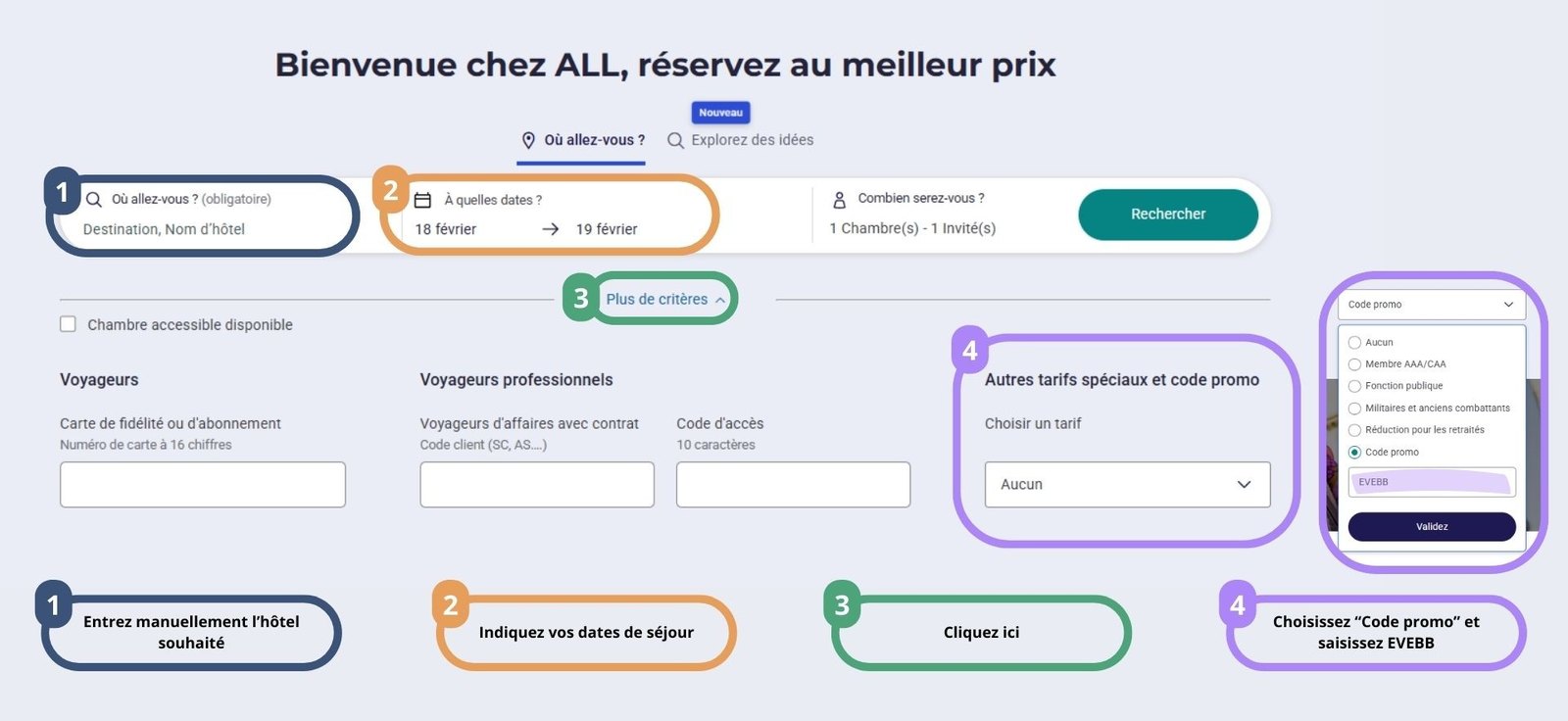
How to book at the conference rate:
- Go to all.accor.com.
- Type the name of one of the three hotels — Sofitel Luxembourg, Novotel Luxembourg or Mama Shelter Luxembourg — into the destination field.
- Enter your arrival and departure dates.
- Click Special rates to expand the options.
- Under Other special rates and promo code, choose Promo Code and enter EVEBB.
- Click Search. The discounted rooms appear, and you can complete the booking.
Staying longer? The conference rate covers the nights of 22 to 25 October only. Book those nights first with the promo code, then contact the hotel's reservations department to add extra nights; rates and availability for those are quoted on request.
Meliá Luxembourg
1 Park Dräi Eechelen · L-1499 Luxembourg
On the Kirchberg plateau, a few stops along the tram line from the venue.
- Rate
- See the linkprices are on the booking page
- Payment
- At check-innothing due in advance
- Cancellation
- Freeuntil 7 days before arrival
- First release
- 7 Sep 2026part of the block goes back
How to book: open the conference booking page and reserve directly. It opens on double occupancy, so change it to single occupancy if you are travelling alone.
The block is released in stages. A first portion goes back to the hotel on 7 September and the remainder about a month before the conference. Rooms booked after that are charged at the hotel's public rate for the day.
Around the city
Beyond the conferenceLuxembourg is one of Europe's smallest countries, bordered by Belgium, France and Germany. Most of it is rural: Ardennes forest and nature parks in the north, sandstone gorges in the Mullerthal to the east, vineyards along the Moselle in the southeast. The capital grew up around a medieval fortress on the cliffs above the Alzette, and its old town is a UNESCO World Heritage site, fifteen minutes from the venue by tram.
Further afield
Direct trainsDirect trains run from Luxembourg Gare Centrale into Belgium, France and Germany, so a day either side of the conference is easy to use.
Organizers
Local organizers
Department of Finance, University of Luxembourg
- Zaruhi Hakobyan
- Christos Koulovatianos
Series organizers
Network Science & Economics
- Jing Cai
- Arun Chandrasekhar
- Ben Golub
- Matthew Jackson
- Sudipta Sarangi

